

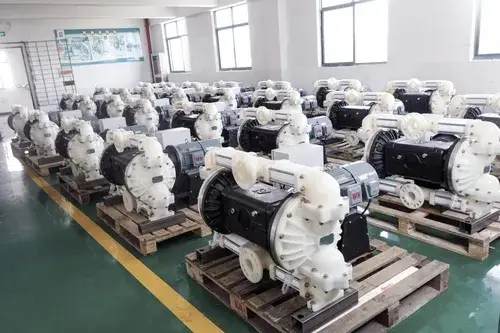
Electric Diaphragm Pumps
Electric diaphragm pumps utilize an electric motor to generate the reciprocating action required for fluid transfer. The motor drives a central shaft via a reduction mechanism and eccentric bearing, synchronously actuating the diaphragms on both sides of the pump chambers. As the diaphragms flex back and forth, they create alternating suction and pressure strokes—drawing fluid into the chambers through the inlet valves and discharging it smoothly through the outlet valves.
The ball check valves open and close automatically with each stroke to ensure positive, unidirectional fluid flow. Because different media present unique chemical properties and viscosity requirements, our diaphragms are engineered in a wide array of materials—including PTFE, FKM (Fluororubber), NBR (Nitrile), Santoprene™, and EPDM (or Polyether-based elastomers). By pairing the pump with the optimal diaphragm material, our electric diaphragm pumps reliably handle chemicals, solvents, coatings, slurries, wastewater, food ingredients, and other challenging industrial fluids that demand steady, shear-sensitive transfer.
- The reciprocating mechanism and reduction unit are housed together, giving the pump a more compact structure and making installation more convenient.
- The reduction output shaft also drives the reciprocating movement, so no additional coupling is needed and the transmission structure remains more compact.
- The housing is designed with a unified mounting base, while the motor is connected through a flange structure to support stable installation and proper alignment.
- Equipped with a larger internal cavity, the housing can hold more lubricating oil, which helps the moving parts run smoothly and supports heat dissipation during operation.
- Linear bearings support the diaphragm pumps reciprocating movement, which reduces friction and makes maintenance or part replacement easier.
- A built-in vent tube helps balance air exchange between the inner cavities on both sides of the diaphragm assembly, supporting smoother diaphragm movement during operation.
-
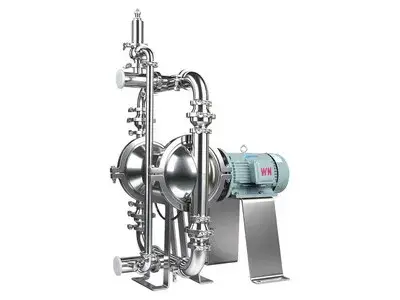 Sanitary Electric Diaphragm Pumps
Sanitary electric diaphragm pumps are used for liquid transfer in processes where cleanliness, material safety, and easy cleaning matter.
-
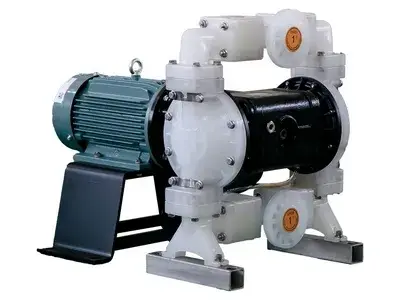 Industrial Electric Diaphragm Pumps
Industrial electric diaphragm pumps use an electric motor to move two diaphragms inside the pump, helping transfer liquid in a smooth, reliable flow.
Electric diaphragm pumps are a practical choice for processes that handle corrosive, viscous, particle-containing, or sensitive liquids. Their steady diaphragm movement supports transfer, circulation, loading, unloading, and wastewater handling in applications such as:
- Automotive Manufacturing: Paint transfer, waste liquid handling, and acid pickling solution transfer during metal parts cleaning and surface preparation.
- Ceramic Production: Slurry movement, wastewater transfer, and liquid material handling across mixing, forming, cleaning, and production stages.
- Chemical Processing: Acid transfer, solvent handling, chemical solution movement, and material transfer between tanks, process lines, and dosing points.
- Food and Beverage Processing: Liquid ingredient transfer and process fluid movement where stable flow, material compatibility, and hygiene requirements need to be considered.
- Printing, Packaging, Pulp, and Paper: Ink, glue, solvent, and adhesive transfer for printing, bonding, circulation, cleaning, and material preparation.
- Water Treatment and Wastewater Management: Clean water transfer, wastewater handling, sludge movement, and treatment fluid transfer across different processing stages.
- Paint and Coating Production: Acrylic, solvent, resin, pigment, and additive transfer during raw material handling, mixing, loading, unloading, and production.